# Filter statements

The **Statements** page in the platform shows all statements that have been created for your account.&#x20;

If you are looking for a specific statement, you can use filters to locate it easily. You can find a statement using criteria, such as statement ID, type (debit or credit), the date it was created, and status. You can also use other filters, such as agreement name, total sales price, and more.

This topic describes how to apply the two commonly used filters, including **Type** and **Status**.

### Filtering statements by type

To view statements based on their type:

1. Go to **Billing** > **Statements**.
2. Select the <img src="data:image/png;base64,iVBORw0KGgoAAAANSUhEUgAAAGAAAABgCAYAAADimHc4AAAAAXNSR0IArs4c6QAAActJREFUeF7t2TFOQ0EQBFF8UgISjkRCwElBpASg0Y5VtnmOZ6e9Vb+Db1+efFIClzRd+BMB8UNAAAExgTheAwiICcTxGkBATCCO1wACYgJxvAYQEBOI4zWAgJhAHK8BBMQE4ngNICAmEMdrAAExgTheAwiICcTxGnBvAp5fXj/j73zT8R/vb6OHejT8fXMCfvdPQNwPAgiICcTxGkBATCCO14BHFxDf7+Hix+8BD0cgvhABBMQE4ngNICAmEMdrAAExgTheAwiICcTxGkBATCCOv3oD7v0vzOmvm1OfBPxBjIDpI7U8T8Ay0Ok6AqbElucJWAY6XUfAlNjyPAHLQKfr7l7A9ML/bf7q7wH/Dej0vgRMiS3PE7AMdLqOgCmx5XkCloFO1xEwJbY8T8Ay0Ok6AqbElucJWAY6XUfAlNjyPAHLQKfrbl7A6X/K1/4xbQr85zwBpwQPzxNwCPD0OAGnBA/PE3AI8PQ4AacED88TcAjw9DgBpwQPz9+8gMP73fxxAmJFBBAQE4jjNYCAmEAcrwEExATieA0gICYQx2sAATGBOF4DCIgJxPEaQEBMII7XAAJiAnG8BhAQE4jjNYCAmEAcrwEExATi+C97b2BhPsA2DAAAAABJRU5ErkJggg==" alt="" data-size="line">**Filter** option in the table.
3. In the **Filters** box, select **Add another condition**, then define the conditions as follows:
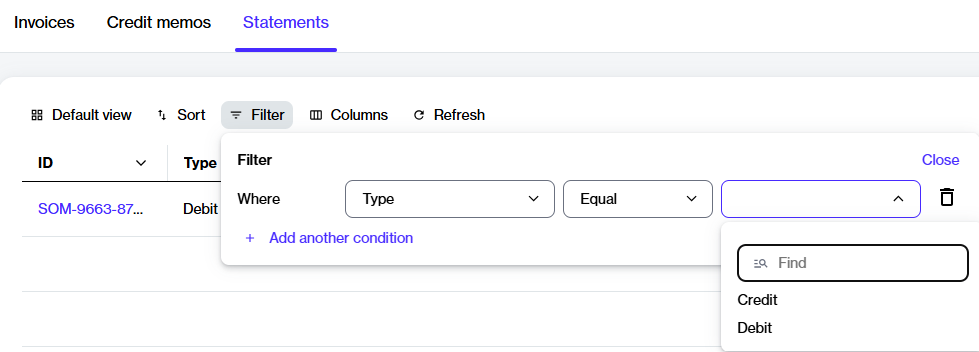
   1. Select **Type**.
   2. Set the condition to **Equal**.
   3. Choose the type of statement: **Debit** or **Credit**.

<div data-with-frame="true"><figure><img src="/files/uB9udU5fSl2yj8cV6nSf" alt=""><figcaption><p>Use the statement type filter to easily find a statement.</p></figcaption></figure></div>

4. **Close** the filter box. All statements matching your specified status are displayed in the table.&#x20;

### Filtering statements by status

To view statements based on their status:

1. Go to **Billing** > **Statements**.
2. Select the <img src="data:image/png;base64,iVBORw0KGgoAAAANSUhEUgAAAGAAAABgCAYAAADimHc4AAAAAXNSR0IArs4c6QAAActJREFUeF7t2TFOQ0EQBFF8UgISjkRCwElBpASg0Y5VtnmOZ6e9Vb+Db1+efFIClzRd+BMB8UNAAAExgTheAwiICcTxGkBATCCO1wACYgJxvAYQEBOI4zWAgJhAHK8BBMQE4ngNICAmEMdrAAExgTheAwiICcTxGnBvAp5fXj/j73zT8R/vb6OHejT8fXMCfvdPQNwPAgiICcTxGkBATCCO14BHFxDf7+Hix+8BD0cgvhABBMQE4ngNICAmEMdrAAExgTheAwiICcTxGkBATCCOv3oD7v0vzOmvm1OfBPxBjIDpI7U8T8Ay0Ok6AqbElucJWAY6XUfAlNjyPAHLQKfr7l7A9ML/bf7q7wH/Dej0vgRMiS3PE7AMdLqOgCmx5XkCloFO1xEwJbY8T8Ay0Ok6AqbElucJWAY6XUfAlNjyPAHLQKfrbl7A6X/K1/4xbQr85zwBpwQPzxNwCPD0OAGnBA/PE3AI8PQ4AacED88TcAjw9DgBpwQPz9+8gMP73fxxAmJFBBAQE4jjNYCAmEAcrwEExATieA0gICYQx2sAATGBOF4DCIgJxPEaQEBMII7XAAJiAnG8BhAQE4jjNYCAmEAcrwEExATi+C97b2BhPsA2DAAAAABJRU5ErkJggg==" alt="" data-size="line">**Filter** option.
3. In the **Filters** box, select **Add another condition**, then define the conditions as follows:
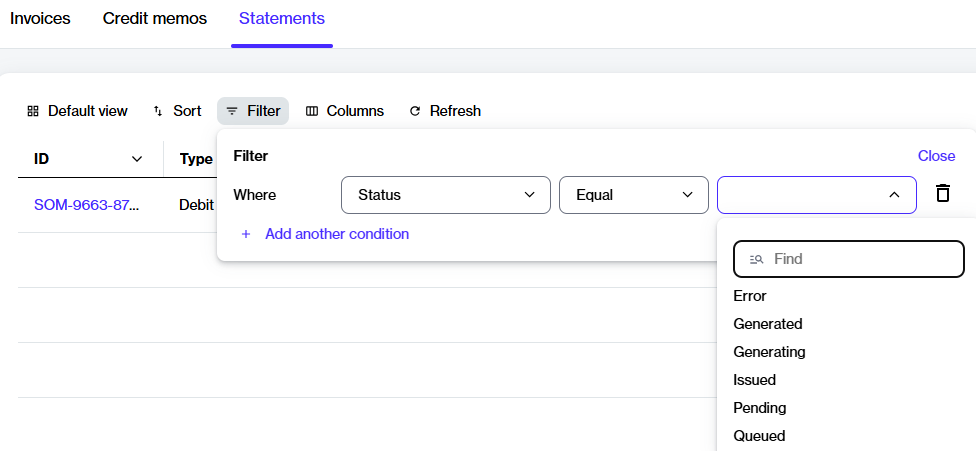
   1. Select **Status**.
   2. Set the condition to **Equal**.
   3. Choose the required status from the list. Options include **Error**, **Generated**, **Generating**, **Issued**, **Pending**, or **Queued**.

<div data-with-frame="true"><figure><img src="/files/04VPXh4YL8liFntrCDC8" alt=""><figcaption><p>Use the statement status filter to find statements based on status.</p></figcaption></figure></div>

4. **Close** the filter box. All statements matching your specified status are displayed in the table.&#x20;


---

# Agent Instructions: Querying This Documentation

If you need additional information that is not directly available in this page, you can query the documentation dynamically by asking a question.

Perform an HTTP GET request on the current page URL with the `ask` query parameter:

```
GET https://docs.platform.softwareone.com/modules-and-features/billing/statements/filter-billing-statements.md?ask=<question>
```

The question should be specific, self-contained, and written in natural language.
The response will contain a direct answer to the question and relevant excerpts and sources from the documentation.

Use this mechanism when the answer is not explicitly present in the current page, you need clarification or additional context, or you want to retrieve related documentation sections.